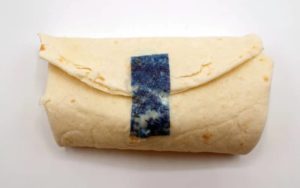
Cooking Breakfast in a Bag

An Experiment in Campfire Cooking

We recently went on a school outing, camping with my daughter’s class, a little something we do a few times a year. We decided to try “breakfast in a bag,” a crazy idea I first read about over at the Lakeland Gear Blog sometime last year.

It works like this.

  1. Line the bottom and sides of a standard paper lunch bag with thick-cut bacon.
  2. Crack two (or more) eggs on top of the bag.
  3. Put over the campfire and let it slowly cook until the grease is about halfway up the bag.
  4. Eat your breakfast.

Two breakfasts on a grate, cooking over a hot bed of coals at a campsite.

Some thoughts on cooking breakfast in a bag.

It was a mixed success.

First, it took longer than I thought, and it was challenging to maintain a cooking surface in the Goldilocks zone, but that was largely due to the participation of too many (young) cooks. Turns out kids like big flames, and I wasn’t always able to dissuade them from tossing more logs on the fire, so it was difficult trying to maintain a nice bed of coals.

Second, and the question everyone asks, wouldn’t the bag just catch on fire? Answer: Yes, if you’re not careful. We lost one bag to fire. As the bacon grease dripped into the fire, flames flared up and engulfed it in an all-consuming inferno. There was much excitement about this.

We replaced it with bag number three.

So, how did it turn out?

Pretty darn good!

The first bag we cooked was a bit crispy on the bottom because we let it cook too long, but our third bag was just about right.

Just-cooked fried edds and bacon on a red plate over a grated campfire.

Like any experiment, we learned a lot. We have another camping trip coming up, and we’re looking forward to trying it again. And yes, it would be faster to cook this breakfast on the camp stove, but it wouldn’t be nearly as much fun.

How to Shave Like a Man

Rediscovering the Civilized Way to Shave

I don’t know exactly when I started shaving regularly, but it was probably when I was 16 years old. Now if you add all those years up (something I try to avoid), I’ve scraped hair off my face with a sharpened piece of metal for something close to 10,000 times. Yet, until recently (and despite what manly sports personalities have been telling me my whole life) I’ve been doing it all wrong.

So it was past time I learned how to shave with a Double-Edge Safety Razor.

Tools of the Trade

First, to get started down the bold path of double-edge (DE) shaving, you need the right tools.

The RazorMerkur 180 Long-Handled Safety Razor

My primary tool of choice is the Merkur 180 Long Handled Chrome Safety Razor. I like it because it’s easy to use and easy to clean. The longer handle on this model makes it a bit easier to maneuver over the contours of my face than other, shorter-handled models.

The BladeAn Astra  brand double-edged razor blade for shaving.

Astra Super-Premium Platinum. Each blade is good for about a week’s worth of shaves, so this box of 100 will last me nearly two years. Another blade option people seem to like (but I haven’t tried) are the more expensive Feather Hi-Stainless Blades.

The BrushEscali Badger Bristle Shaving Brush

Escali 100% Pure Badger Shaving Brush. I read a lot about the difference between synthetic and natural brushes. In the end, I went with a badger-bristle brush, for no other reason than badger hair has been used with success for a long time. I’ve never used anything else, but I really like how the badger fur holds water and lathers up nicely.

The SoapA jar of Taylor of Old Bond Street Sandalwood Shaving Soap

Taylor of Old Bond Street Sandalwood Shaving Cream. It’s got a nostalgic, earthy scent that reminds me of barbershops from back in the day. A jar seems to last me three months or so. I’ve also used Proraso Eucalyptus & Menthol Shaving Soap, which has a bracing minty scent and makes the skin tingle pleasantly.

The Technique

  1. Preparation. Get your face wet using hot water. I’ve had the best results when shaving right after I step out of the shower. Also, using a hot towel works wonders to soften the hair and get the beard ready for a close shave. It feels really good, too.
    Apply soap to your brush — you want a good, thick lather, so experiment with what works best for you — then stir it in a mug or bowl to get it good and lathered up. Apply to your face liberally, working the lather in with broad, circular strokes to really make the beard stand up.
  2. Process. With the razor, use smooth strokes, shaving with the grain of your beard, angling the razor between 30 to 45 degrees, and rinsing in cold water between the strokes.
    This can be tricky, at times, mainly around the sharper angles of your jawline and chin, especially if you’ve been a cartridge-shaver your whole life. But you’ll quickly learn where your sensitive spots are and how to shave around them. For instance, I have a spot on my chin (left over from an injury during a foolish moment in college) I always cut if I’m not careful.
    One tip for a really smooth shave: pull the skin taut to make the hairs stand up, and that helps to cut them off right at the skin level.When you’re done, later up and repeat for a really close shave.
  3. Pressure. You don’t need a lot of it. These razors are heavier than a standard plastic cartridge razor, so there’s no need to press hard against the skin. In fact, if you use too much pressure you’re going to hurt yourself (trust me on this). Let the weight of the razor do the work.
  4. Patience. If you rush your shave, you’ll get cut. Personally, I’m rushed in so many other areas of my life these days, I really enjoy the ritual of slowing down to shave. So much so, in fact, I look forward to shaving each morning.
  5. Pay attention. I mean seriously. You’ve got a razor blade against your face. You can (and probably will) cut yourself if you’re not watching what you’re doing. After a while it becomes a more routine, but it’s never something you should do without  a certain amount of care. When the mind wanders, the blood will flow.

The Finish

When it’s all over, I rinse my face in cold water. That’s all you really need, but I like to finish it off with a little Lay-Rite No. 9.

And while the whole process may seem complex, it’s a fabulous morning ritual. And besides, it’s a lot easier than shaving in space.

So, what about cost?

I used to use a Gillette Mach 3 (with three blades for a closer shave!). The initial buy-in wasn’t too bad: $13 for the razor and two cartridges. Shaving cream can be cheap ($5 or less for can). But the cartridges, the actual blades that do the work, are really expensive (nearly $30 for a pack of 10). yeah, I know they say they’re good for months, but I’ve seldom had a cartridge last me more than a week. I got tired of shelling out $150 or so a year in blades.

My whole set-up listed above (razor, two years’ of blades, soap, and brush) was only $85. Add another $45 for three more jars of shaving cream, and I’m still paying $20 less than I would for a year’s supply of cartridges alone.

Anything else?

Safety Razor, Shaving Brush, and Stand

Care and storing of your brush. Conventional wisdom tells us it’s important to dry your brush. Most manufacturers recommend storing it bristles down so it can dry properly, extending the life of your brush. So, with that in mind, I sprung for a razor and brush stand.

It looks — and works — great.

Credits

This post is the result of months of self-experimentation and a little research. As I cobbled it together, I had three main sources of reliable information. They are, in no particular order:


Death Plays a Foul Game at the Cockfight Club

Trouble with Gamecocks

Black-and-white illustration of a gamecock. Drawn by Paul Pope.

Death Plays a Foul Game.
Artwork by Paul Pope.

As reported by The Eastsider L.A., earlier this year Los Angeles police shut down a Montecito Heights cockfighting ring, resulting in the arrest of 20 people and the confiscation of 36 roosters (35 living; one dead) that had been groomed for cockfighting and nearly $6,000 cash.

Then, just a few weeks ago, something similar happened in Camarillo when police raided a cockfighting arena.

So of course I was reminded of the time fictional detective Ben Drake, main character of By the Balls: The Complete Collection (written by me and Jim Pascoe), followed a girl — and found himself in the middle of an imbroglio at the Cockfight Club.

Here’s a short excerpt from that crime fiction tale, titled “Death Plays a Foul Game:”

I saw her glance my way. The expression on her face puzzled me: a combination of playful indifference and joyous vindictiveness. Specifically, the way she latched onto this guy’s huge arm and the way she leaned up to plant a kiss on his cheek suggested that she must be doing this mostly for my benefit. Whatever.

Trying my best to ignore her, I walked over to the pit. I couldn’t deny that I was curious about what this cockfighting business was all about. Besides, it couldn’t hurt to blend into the crowd a little better.

I guess I thought I’d see two roosters beating the feathers out of each other, real no-holds-barred action. Instead, what was most likely the end of the fight found these two fighters tired, barely able to stand, and only occasionally lunging in to peck at the other’s head.

I had to struggle to see these birds, both because of the crowd in front of me and because of the three guys huddled in the pit with them. A guy crouched behind each cock, tending to it. The guy nursing the more-injured rooster lovingly stroked the bird’s neck while trying to wipe the blood from the animal’s eyes. He even stuck the rooster’s head in his mouth; when he pulled it out, he spit the excess blood onto the dirt. Then it was ready to fight again.

Instead of watching the last throes of the fight, I found myself intrigued by the third man. Unlike the other two fellows, who wore dirty T-shirts and faded, muddy jeans, this one came decked out in a gray sharkskin suit, an open-collar tuxedo shirt, and a Mexican wrestling mask.

He looked like a dance hall demon, except this was no dance hall. He squatted down, knees pointing outward, and hovered over the men and their birds. He shook in a fit of ecstasy or hysteria—probably drug-induced—as he counted to ten. He drew two lines in the dirt with his index finger, then the men placed their roosters behind the lines. Wings outstretched, the cocks met in one last, tired embrace.

The end was quick: the one rooster fell beneath its stronger opponent. More blood had covered the losing cock’s eyes—only this time, they were closed. The poor bird laid there like a wet towel, its feathers dark and slicked with blood. The winning cock walked around the loser. My eyes caught the reflection of the bloodied knife strapped to the shaft of its left leg.

The story itself is a bit of an homage to Charles Willeford’s Cockfighter, with a brief nod or two to Chuck Palahniuk‘s Fight Club.

The (First) Time I Fell in Love

I fell in love for the first time in 1972. I was four years old. She was sixteen.

Or at least sixteen, probably a little older. She lived next door. I remember her as the daughter of the family living there, but I can’t be sure that’s true. I never talked to her, and I don’t even think I ever saw her face. I do remember she had shoulder-length blonde hair, and I do have exactly one memory of her.

She’s walking to her house. Her back is to me. She’s wearing a floral print dress. It’s probably June, but maybe late May or early July.

While that’s the only vague memory I have of the girl herself, I have a very vivid memory of what she drove — a candy apple red first generation Ford Mustang convertible. I’m not sure of the exact year, but in my mind, it’s a 1968.

I’m not a car guy by any means, but every time I see a candy apple red Ford Mustang convertible (which isn’t often), that short memory re-plays my head a few times, not unlike a Vine.

And that’s why the 1968 Mustang convertible is one of three cars that has an emotional effect on me. There’s also the promise of the flying car from my youth. And then, of course, there’s the last of the V8 Interceptors.

“INTERCEPTOR (Last of the V8s)”

INTERCEPTOR (Last of the V8s) by Joshua Budich. From the author’s collection.

Book Launch! By the Balls: The Complete Collection

The Triumphant Return of Ben Drake, Private Detective

By the Balls: The Complete CollectionFifteen years ago, Jim Pascoe and I wrote a book together. That book, By the Balls: A Bowling Alley Murder Mystery,  became the cornerstone of UglyTown, the independent mystery publishing house we co-founded and ran for more than 12 years.

So today, roughly 15 years after the original By the Balls, I’m pleased to announce that By the Balls: The Complete Collection has now been officially released from Akashic Books and is available for purchase in paperback and a variety of ebook formats at finer booksellers everywhere.

The book collects all the exploits of detective Ben Drake as he investigates cases across the crime-filled landscape of Testacy City. It collects By the Balls and the follow-up Five Shots and a Funeral, as well as a handful of other archival, hard-to-find short stories and two all-new pieces of short fiction, “Fireproof” and “Across the Line,” written specifically for this collection.

If you want to know more, read They Came from UglyTown, an extensive review/interview/discussion with Jim & I about the book, collaboration, and the intersection of writing & publishing, over at Criminal Class Press.

And if you’re in Los Angeles on Friday night (April 5), please come see us at Skylight Books for the official By the Balls launch. It starts at 7:00 p.m.


Everything You Need to Know About Making Perfect Hard Boiled Eggs

There are a million egg stories in the naked city, and this is one of them.

It doesn’t take long to find out that there are a great many different techniques for creating a batch of “perfecthard-boiled eggs. Some authors even advocate baking them in the oven or resorting to the drastic step of hard-boiling the eggs in a pressure cooker.

The Norwegians cracked the scientific code behind hard-boiled eggs to help you cook your eggs to perfection. There’s even an egg-cooking robot. And then there’s this thing.

Eggs

Denaturing the Protein

Eggs are primarily made up of protein, and when you subject them to heat, you denature that protein, which is why they change from a runny mostly liquid consistency to a solid, rubbery consistency. Marshall Brain explains the process nicely in this episode of the How Stuff Works podcast (a favorite of mine).

Cooking for Geeks CoverThe trouble with eggs is that the yolk (yellow) and the albumen (white) denature at different temperatures. Jeff Potter, author of Cooking for Geeks, has an elegant solution for this, one he calls the “Shock and Awe Method.” You can read about it in detail on page 183 of Cooking for Geeks, a book you should totally buy. But, in the meantime …

 Here’s how it works.

First, you’ll need these things:

  •  One dozen (or more) eggs.
  • Two pots of the same or similar size, filled with water that will cover the eggs

Then you need to do this:

  1. Bring one of your pots to a roiling boil.
  2. Place your eggs in this pot for 30 seconds.
  3. Remove them and place them in the other pot in room temperature water.
  4. Bring this pot to a boil, then simmer for eight to 12 minutes.

Perfect Egg YolksI usually stop the process after eight minutes (and not just because “egg” and “eight” both start with “e”). I’ve found the yolks are nice and flaky by then — and they’re hot, so they keep cooking. I’ll run some cold water over them to cool them down (after eating one first as a sample), then pop them in the refrigerator.

I’ve always had good results with this method. The eggs remain easy to peel and the yolks are solid, flaky, and never green or gray around the outside even after refrigeration.

I’ve never had any trouble peeling eggs cooked with this method, but if you do, conventional wisdom says that you can add a teaspoon of baking soda during the boiling process or you can just blow them out of the shell, like Tim Ferriss.

The bad news.

The only downside to making perfect hard boiled eggs with method is the time it takes. The whole process takes around 40 minutes, which seems a like a lot for a dozen eggs.

But then, you can’t rush perfection.


The Developmental Milestone I Didn’t Need to Witness

A banana and a hobo's hangout.That Which Cannot be Unseen

Parents, especially new, first-time parents, obsess over developmental milestones. And rightly so—these are really great moments in the lives of parents. For me, nothing beats the amazement of watching your child learn to read. However, there’s one milestone that isn’t in the books and that I did not see coming.

Okay, so that’s not entirely true. I did see it coming. Eventually. But I definitely did not envision me actually being there when it happened.

Let me tell you a story.

On March 19,2013, I pick my gals up from school, like I do pretty much every day, we pile into the Bently* and head for home, chatting about the events of the day as we go. This is always an enjoyable part of my day. So we’re following the usual route and make the standard right turn onto a busy, one-way street and start motoring toward the freeway.

But, before we reach the on ramp, we drive by a recently installed single-hobo bivouac displaying an extraordinary number of possessions. The hobo in question is standing in front of his makeshift bed, wearing a baseball cap, ragged socks with beat-up shoes, and a pair of elastic-waistband shorts.

 Here’s the fun part.

So this fellow has his shorts pulled halfway down his thighs and he’s arranging his nether regions — right there on a busy street, a street which provides access two major highways in as many blocks, for everyone to see.

So great. Maybe no one but me noticed.

We drive in uncharacteristic silence for a few moments. Then my oldest daughter says,

“OMG. I just that guy’s … you know … stuff.”

Yeah, I knew. Then my youngest daughter says,

“I saw it, too.”

So there it is. March 19, 2013. The day both my daughters first saw a man’s penis.

People who know me have heard me say that one day my daughters will see a man’s penis, but it definitely won’t be mine.

Mission accomplished!

*Note: not really a Bentley.


Gear Review: BioLite CampStove

Power on the Go with the BioLite CampStove

Self-portrait of the author on a camera phone with the BioLite CsmpStove.

The author gets a charge out of his new BioLite Stove.

I read about the BioLite CampStove in August 2012 as part of the GearJunkie‘s Outdoor Retailer Best-in-Show wrap-up. (there’s plenty of other cool stuff in that post as well).

Anyway, being a fella who likes to cook in the out of doors, I was intrigued. So I ordered one direct from BioLite and gave it a try.

What’s in the box.

The stove itself is comprised of two pieces, a metal Fuel Chamber (weighing 18 ounces/515 grams) and an orange Power Module (14.5 ounces/417 grams), which is a thermoelectric generator, a small fan, and a lithium-ion battery. Here’s how the BioLite Stove works.

It also comes with a snap-on pot stand, a short (yellow) USB cable, a small packet of firestarter sticks (which I did not use), and a convenient stuff sack to hold everything. All together my BioLite stove (not including the firestarter sticks) weighs in at 34.5 ounces (982 grams). A little heavier than I prefer for backpacking, but not too bad overall. By comparison, my JetBoil Sol Ti with a full fuel canister weighs a mere 20.5oz (580grams)—and takes up less volume in my pack.

Getting ready to burn.

The assembled BioLite CampStove.The BioLite Stove has a really nice design that makes it easy to set up and use. The Power Module slides right into the Fuel Chamber. There’s really only one way it can fit, so it’s pretty error-proof.

Like any device you buy with lithium-ion battery, it’s recommended that you condition (prime) the battery before using it for the first time, so I charged the battery using a (not included) USB adapter and a standard wall outlet.

Fire!

I loaded up the fuel chamber with some tinder and kindling, tossed in a match, and it started right up. The fuel chamber operates similar to a chimney-method of lighting a charcoal grill.

After I fed the fire with a little more fuel, I pushed the button on the Power Module to LO. The fan clicked on, giving the fire a flow of oxygen, and things really started to burn. I added some more fuel and waited a few moments. BioLite CAmpStove with a good amount of flame.

It didn’t take long for the fire to really get roaring. I pressed the button again to switch the Power Module to HI. This got the fan going even faster, and in almost no time, the light on the Power Module turned green.

I plugged in my phone and commenced charging.

Top-down view of the BioLite CampStove Fuel Chamber with coals.Overall, the stove charged the phone just fine, but it didn’t charge it very much. I was a bit surprised at how soon the Power Module ran out of juice, considering the experiment started with a full charge from a wall outlet.

Now this was just an out-of-the-box test, so I didn’t pack the Fuel Chamber as full as I could have, but from this initial test, I’m guessing It’s going to take a lot of continually burning biomass to get a phone to a full charge.

So for the next test, I’m going to see just how much fuel I need to burn and how long it takes to get a full charge on a phone.

I’ll probably try out boiling some water on the pot stand, too.

John Muir Trail: How to Plan for Adventure

Planning for Adventure Along the JMT

When undertaking any endeavor of reasonable difficulty in unknown territory, it’s important to be prepared. So when I decided to hike the John Muir Trail, I did a good amount of research. I relied on two books in particular to help me effectively plan the trip.

Ultimate Hiker's Gear Guide and the Essential Guide to the John Muir Trail.

Reference material from the author’s adventure library.

Essential Resources

The Ultimate Hiker’s Gear Guide: Tools and Techniques to Hit the Trail

Book Cover-The Ultimate Hiker's Gear Guide: Tools and Techniques to Hit the TrailBy Andrew Skurka

Skurka is a well-known long distance hiker who was the first to complete the 6,875-mile Great Western Loop and the 7,775-mile Sea-to-Sea Route, among many other hiking and endurance adventures.

So he knows about traveling fast, light, and going solo. His advice in the book helped me figure out my nutrition (although there was never enough food on the trail) and make more informed gear choices to keep my pack weight under 30 pounds.

John Muir Trail: The essential guide to hiking America’s most famous trail

John Muir Trail: The essential guide to hiking America's most famous trailBy Elizabeth Wenk with Kathy Morey

This was my go-to book for planning the trip. It has very detailed descriptions of the trail, from main features, flora and fauna to watch for, tempting side trails to explore, and details of individual camp sites (which I didn’t truly appreciate until I was on the trail), along with a good bit of history about the trail along the way.

I quite literally tore this book apart and carried the entire North to South section (pages 62 to 140) with me on my trek. Each night, in the fleeting moments before I feel asleep, I would read about what I had to look forward to during the next day.

John Muir Trail Map-Pack: Shaded Relief Topo Maps

John Muir Trail Map-Pack: Shaded Relief Topo Maps From Tom Harrison Maps

I’ve come to trust Tom Harrison Maps for adventuring in the San Gabriel Mountains, and they were great for giving me an overview of trail highlights and for planning. And while I did carry them on the journey, and they served me well, if I had to do it again, I would use Halfmile’s maps of the PCT (the JMT is section H).

Additional Resources

I also consulted a few online sources for information, most notably the John Muir Trail section of the recently redesigned Pacific Crest Trail Association (PCTA)—this elevation profile was particularly useful—and Darrell Harmon’s short but well done John Muir Trail journal from 2010.

What I Think About When I Think About Flying Cars

I remember a great many things from my childhood, but when I try to think back to third grade, I can recall three (and only three) distinct memories from that year. My favorite, which I remember with crystal clarity, is about flying cars.

One of the textbooks we used included an image of a flying car on one of its right-hand pages.

In the picture, two couples sat in a four-seat flying car. The car, a slick cherry-red number with white leather seats and impressive tail fins, sped through the troposphere. I often imagined it would fly right off the page.

This particular car carried four people — a man and a woman in the front seat, and a man and a woman in the back seat — all decked out in 1950s high fashion (in the 1970s, for my Midwest upbringing anyway, the future looked a lot like the 1950s).

These people oozed success and happiness. The driver had his head back over his shoulder, a gentle laugh bubbling from his lips, as he talked to the couple behind him, perhaps giving them a tour of the promise this brave, new future held.

I’m guessing they were supposed to be in their late 20s to early 30s. Both women were probably homemakers. Both men were probably aerospace engineers or mainframe technicians. There were other flying cars in the near background and a fantastical future structure in the far background. It was a wondrous z-axis superhighway.

Over the years, I’ve tried to find that picture again, without success. I can’t remember what the book was called, or even the subject matter.

I, along with the rest of the Internet, recently ran across photographer Renaud Marion‘s “Air Drive” series of retro-futuristic hover cars, and I find them very appealing and quite comforting.

Flying Car | Renaud Marion | 29 Chevrolet | Air Drive

Please check them out. They’re quite fantastic.